

I was worried this would be as blunt as the marketing made it out to be. I’m overjoyed that it wasn’t.
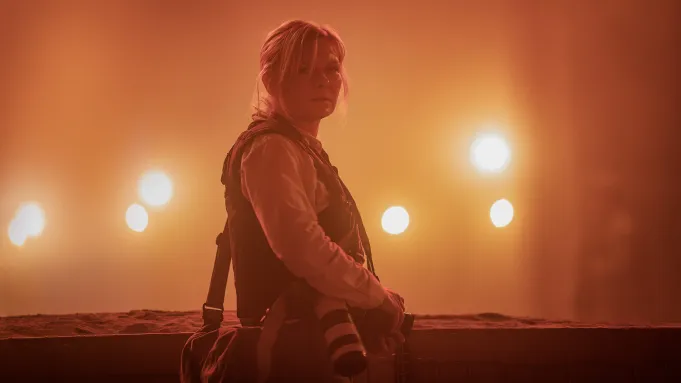
Alex Garland seems to be a rather befuddling filmmaker for so many. The final scenes of Annihilation, the meaning behind Ava’s actions in Ex Machina (I found it pretty obvious but apparently there is discourse), and the entirety of Men have all left some scratching their heads. While the guy can be subtle enough to confound viewers, the trailer for his latest, Civil War, appears to be him embracing a more direct technique. What he’s actually done here is something far more interesting and digressive than I could have hoped for.
The President is announcing that he is on the eve of victory against the possibly nefarious “Western Forces.” No one says what his politics are and he is called a fascist by many, a word so over-utilized in an increasingly online world that it has lost almost all meaning. The Western Forces are made up of Texas and California, two states that are insanely different on paper even as eastern California grows increasingly conservative and Silicon Valley is owned by libertarian tech billionaires. Florida has seceded on its own, taking a few states with it. The rest of the loyalists are made up of the Midwest; small towns and farms that we are constantly told are just pretending there’s no war.
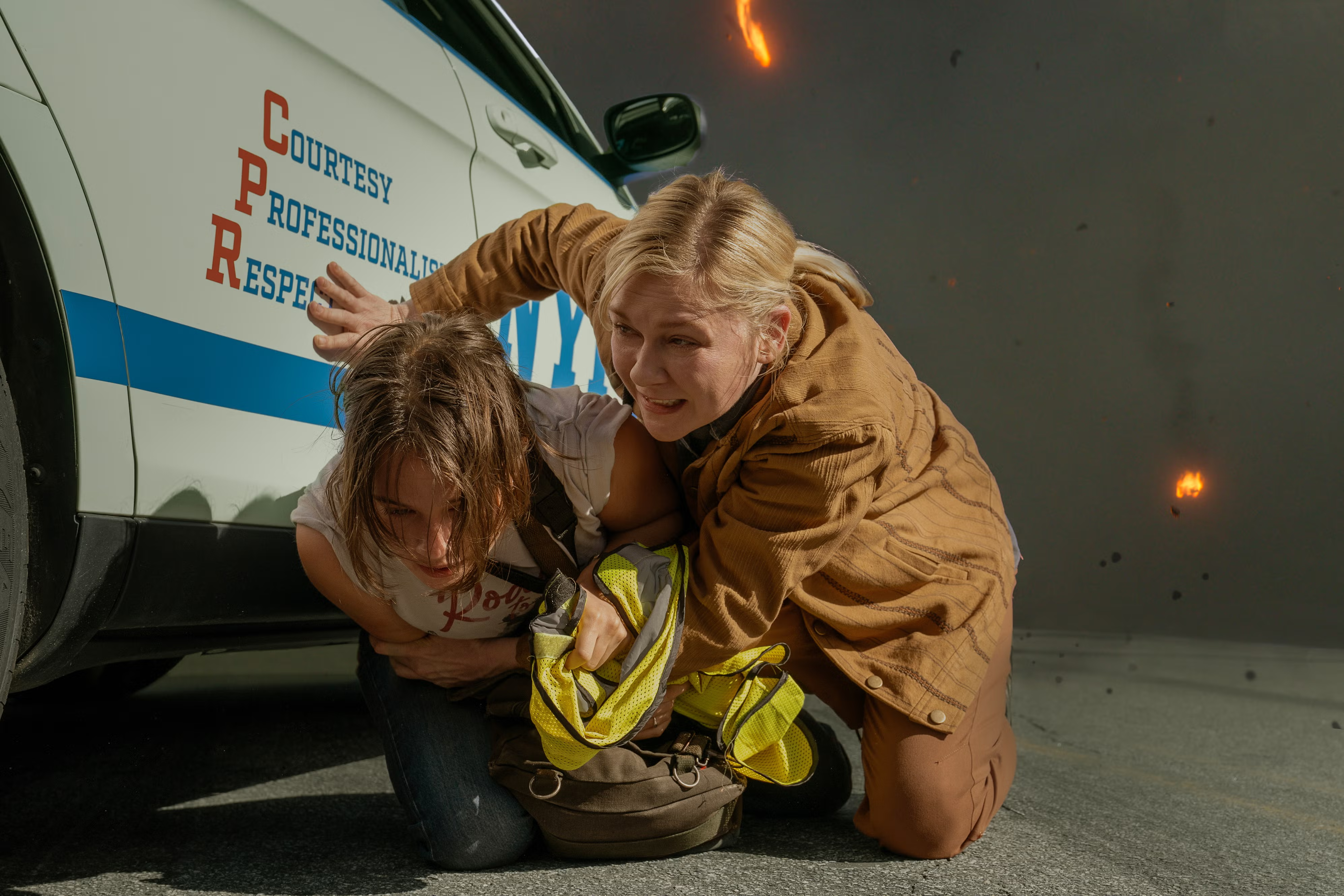
Imagery is meant to be powerful, a sight that is thematically and literally forced on the viewing audience. Hollywood has spent decades offering imagery of terrorist acts and brutal gunfire on foreign soil but there’s something newly upsetting by Garland showing it to us on home turf. A crashed helicopter in the desert? We’ve seen that. But hardened war photographer Lee (Kristin Dunst) guiding budding young newsie Jessie (Cailee Spaeny) to photograph one in the parking lot of a J.C. Penny, a crushed stretcher underneath with too much viscera to tell if a body was also destroyed? It paints a different picture, one that hits too close to home.
Jessie joins Lee and her journalist partner, Joel (Wagner Moura), as they journey to Washington D.C. in hopes of interviewing the president as his third term is brought to a halt. The two work for Reuters, a journalistic organization that claims to maintain neutrality with no bias. Along for the ride is aged New York Times writer Sammy (Stephen McKinley Henderson), Lee’s mentor and a liability that all remain aware of. Jessie sobs in the backseat after an upsetting encounter while Sammy limps to the other side, Lee irritated and stating that the backseat is somehow both an old folk’s home and kindergarten. She is tired and annoyed with everyone while Joel’s getting hard at the gunfire he can hear nearby.
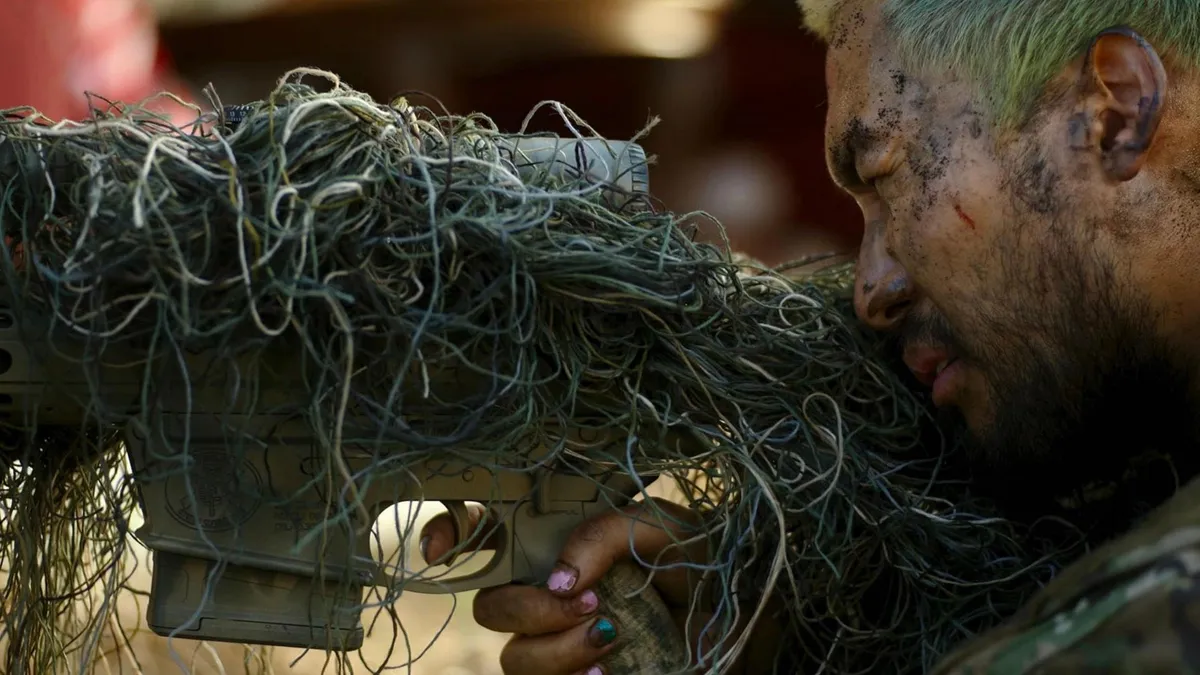
This is our merry band of adventurers, brought together to try and capture the most important moment of the war. Audiences will not be given a breakdown of why the country has crumbled or who is on what side. It is no longer about that, but instead about survival and willful dehumanization that is usually reserved for big-screen portrayals of other countries. This doesn’t feel like a zombie movie or an apocalypse, this feels like rural America being caught in the throes of battle with no purpose. You will get out of Alex Garland’s Civil War what you take in with you, a Rorschach test that eventually reveals its hand and holds a mirror up to the audience.
Perhaps no two things could do this better than Lee’s Wikipedia origin story and a later scene with her husband, Jesse Plemons. The former reveals that Lee is famous for a photograph of “The A.N.T.I.F.A. Massacre,” a statement that tasks the audience with figuring out if the non-existent organization was massacred or did the massacreing. A smart viewer will remember that this fake organization isn’t real and that those slaughtering people they believe to be a part of it would absolutely use that as a headline of victory. I feel that this is later confirmed when Plemons (a soldier whose loyalty is never revealed) states that Lee and Jessie are okay because they’re from Colorado and Missouri, the “real America,” while Joel isn’t because he is from Florida, deemed “Central America.” This sort of too-online rhetoric is the type of thing that a situation like this leaks out into the world, reinforced by the fact they are dumping a truckload of bodies (mostly people of color) into a mass grave while they threaten the journalists with their rifles. This sunkissed simmer of a scene is the most frightening moment of the film and confirms just what fears Garland is putting out into the world.

Plemons, a “when’s he bad” actor, may steal this scene but the entire cast is on fire. Dunst is in complete control of the screen as a traumatized professional that continues to tell herself that she’s fine. Joined by Moura, a live-wire that’s a bit of an alcoholic horn-dog when in character, lights up the room with every energetic moment he’s onscreen. Henderson is consistent as a character actor, never phoning in a performance, but Spaeny is the one that shines brightest. The Priscilla actress is conveying so much with her body language, creating an newbie to the field of war photography that hasn’t set in her skin long enough yet. When the four are briefly joined by Nelson Lee and Evan Lai, portraying to Hongkong reporters, everything fires on all cylinders as we rocket toward our finale.
This type of violence and upsetting imagery is tracked by a series of older jams from the 70s and 80s, somewhat upbeat and electronic to clash with the dour sights and sounds. Perhaps the most fun is De La Soul’s “Say No Go,” a popular mashup song from 1989, that plays while prisoners of war are executed. Isn’t that entire thought just grim? It should be, because that glee at execution is a large part of why this film works. It’s music upholds that sensation and thought that there are people that would love to unleash this behavior in their lives and it’s as chilling as it is personal.

As I said you’re going to get out of this what you take in. Garland has never been more top of his game than in Civil War, which combines the vagueness of Men with the potential militaristic elements of Annihilation and the character drama of Ex Machina. Those still on the fence about his directing career will see what it looks like when he crystalizes. It’s a film that I think is fairly important and the things that make it so are why it will be forgotten in six weeks. See it while you can.
Civil War is currently in theatres.

 WRITE DRUNK; EDIT DRUNK
1 Comment