
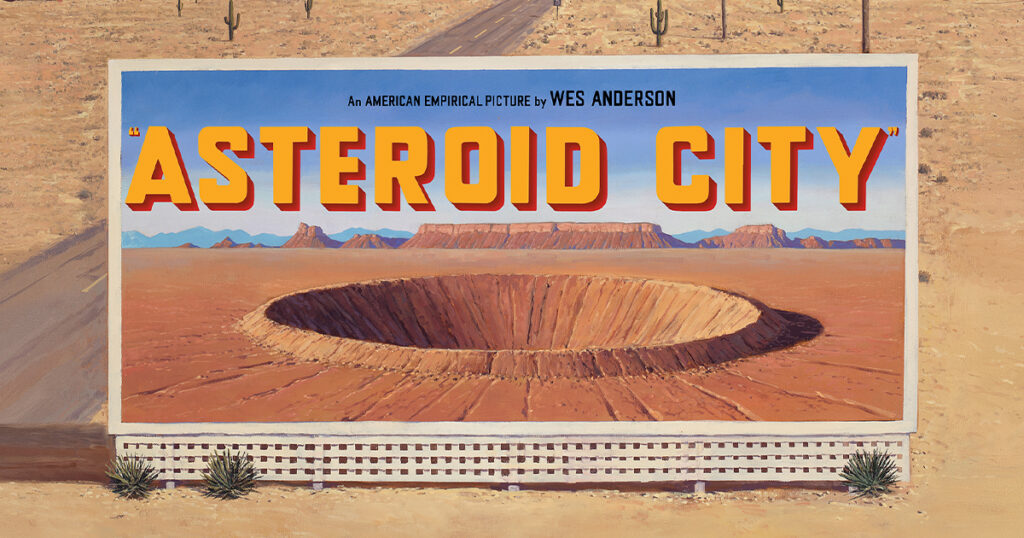
What is a Wes Anderson film? They’re all quite twee, indulge in the ennui and grief of upper-middle-class white Americans, and each individual film is shot to look like storybook sketches containing real human beings. There are flat deliveries, gorgeous costumes, and, yes, even some perturbingly niche music choices. But that doesn’t quite get to the core of what a Wes Anderson film is.
Asteroid City takes those simmering depths and lays them bare onscreen.

Set in 1955, the film follows Auggie Steenbeck (Jason Schwartzman) and his four children as they grieve the loss of Auggie’s wife (Margot Robbie). Arriving in Asteroid City for the Junior Stargazer Convention, the family quickly disperses to their own devices as they struggle with their sorrow. The three young girls play witches, reciting made-up gobbledygook as a spell to resurrect their mother’s ashes into the person she was. Auggie’s son, Woodrow (Jake Ryan), spends his time coming out of his shell with his nerdy peers and Dinah Campbell (Grace Edwards), a young woman who brought her own invention to the gathering. Auggie may be grieving but flirting with movie star Midge Campbell (Scarlett Johansson), Dinah’s mother, must be soothing that wound at least a little.
Except this film isn’t a charming little sci-fi story in the desert. It’s a play, written by Conrad Earp (Edward Norton) and directed by Schubert Green (Adrien Brody), and a documentary about the behind-the-scenes interactions that led to the play becoming the colorized film we see. This show, hosted by Bryan Cranston, is shot in academy ratio and utilizes black-and-white photography to separate itself from the colorized full-screen story the play embodies.
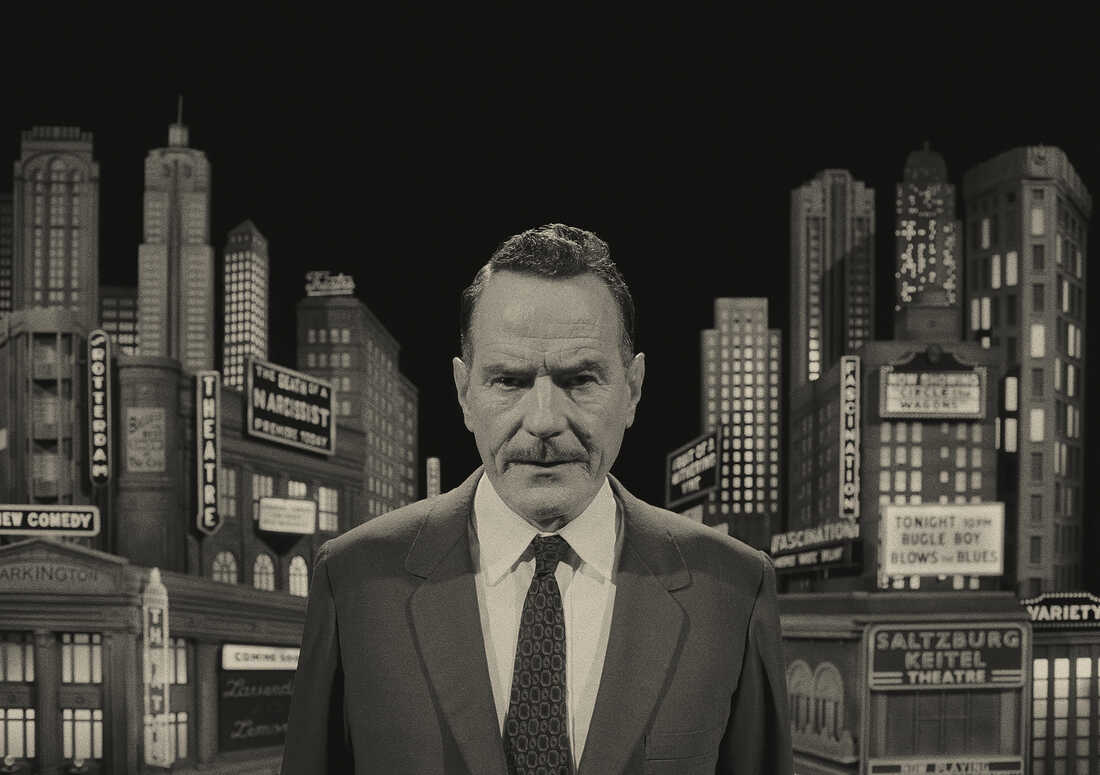
I honestly can’t tell if Wes Anderson has ignored all press and discussion of his film style or if he reads every word and has bought into it all with an alarming severity. This is, perhaps, the most “him” the French Dispatch director has ever been. His gorgeously constructed dioramas, containing his very controlled human performers, give him the sense of control over the world that his audience has always suspected he desires despite the fact that his movie within a play within a documentary is all about sudden inspiration and a lack of control over the universe. Asteroid City is a blunt portrayal of everything the director has ever grappled with.
Within its structure lay a multitude of characters but none so sharp and focused as Auggie and Midge, two damaged individuals that feel a mutual attraction but are hesitant to act on it due to outside circumstances. They talk window to window, Midge running lines with Auggie and exposing her fully naked body in a seduction scene that is as funny as it is relatable. Auggie quietly develops his photographs, capturing the town and its residents in well-framed black and white photos. Sure, one of them is an alien (Jeff Goldblum, or is it?), but the majority attempt to capture Midge even as she practices releasing herself to a different personality for a role. Johansson pulls off the MVP work here, embracing everything that makes a traditional Wes Anderson character and developing it further. She’s a movie star, like almost everyone in the film (Tom Hanks is a welcome addition to this stable of actors), but she manages to make that a piece of her character’s depression and charm all at the same time.

Longtime Anderson collaborator Robert Yeoman has shot the hell out of this one. Each scene feels so full of life, the camera moving in a way that invites us to feel as though we’re watching multiple different styles of performance at once. Yoeman shoots most of the director’s films but he’s outdone himself with the shoebox diorama sensation of Asteroid City. Capturing production designer Adam Stockhausen’s gorgeous layouts that feel all at once cartoonish and grounded depending on the scene’s requirement.

So what is a Wes Anderson film? It’s Asteroid City, a film so steeped in the director’s oeuvre while exploring the very structure and design of those sensibilities down to the bone. It’s a film made for Anderson and his fans alone, unlikely to turn any new heads while delighting those that follow him through anything. It’s taking the idea that you can exert any control over the world, one’s emotions, or one’s destination and blowing that out of the water by shocking us with the reality that there is no control over those things. And I loved it. I loved it to pieces.
Asteroid City is now in wide release in theatres everywhere.

 WRITE DRUNK; EDIT DRUNK
1 Comment